


About Sangha House
No matter who you, you’re welcome here.
“Sangha House is a haven of transformation and creativity for individuals on their journey in life.”
Tucked in the heart of Rogers Park,
Sangha House is a space for stillness, creativity, and community — a home for people exploring what it means to live with awareness in a busy, complicated world.
We believe meditation isn’t about escaping life — it’s about engaging it more fully. At Sangha House, ancient Buddhist wisdom meets modern mindfulness, art, and personal expression. It’s where a meditation cushion can sit beside a canvas, and where conversations about compassion are as natural as conversations about design, recovery, or creativity.
The house itself is both literal and symbolic: a gathering place where people come together to sit, make, learn, and rest. Residents live here temporarily — creating art, developing projects, studying philosophy, or simply reconnecting with purpose. Visitors drop in for classes, workshops, or community meditations that welcome everyone from complete beginners to longtime practitioners.
Everything we do is grounded in kindness, curiosity, and connection. Whether it’s a meditation class, a creative collaboration, or an evening spent discussing the teachings of the Buddha, Sangha House holds space for transformation — the kind that starts quietly and grows through community.
Our programs and events are designed to be inclusive, donation-based, and accessible. Some nights you’ll find candlelit meditations; other days, an open studio filled with laughter, paint, and conversation. The goal is never perfection — it’s participation.
Sangha House is sustained by the people who fill it — residents, volunteers, and guests who share their energy, time, and creativity. Every class, every candle poured, every shared meal is part of a collective effort to build something rare in modern life: a place where mindfulness and meaning aren’t theoretical, but lived.
If you’re searching for community, inspiration, or simply a quiet place to breathe, you’re already part of what Sangha House represents.
The History of 1430 W. Jarvis Ave, Chicago (Rogers Park)
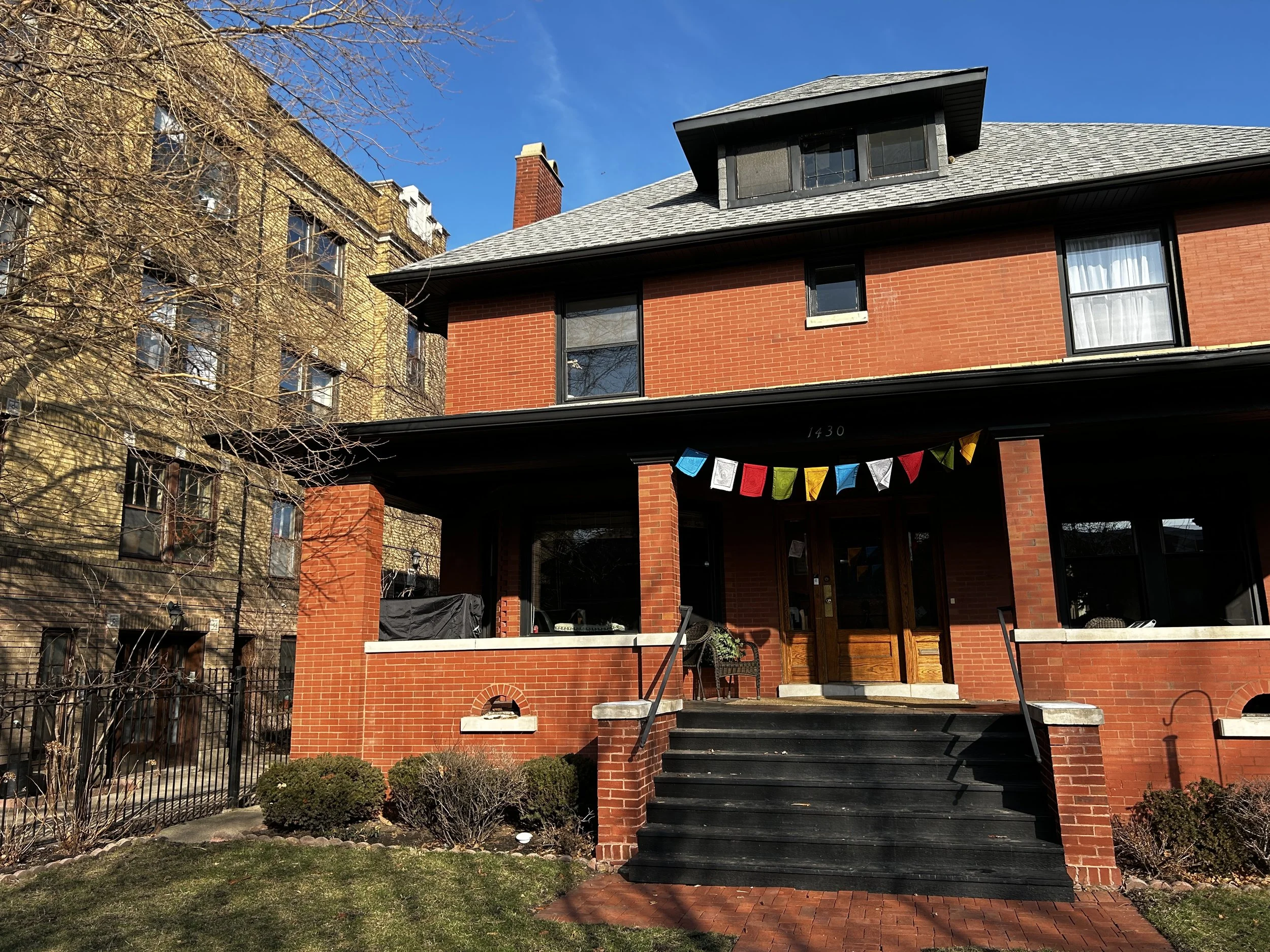
If you’ve ever walked down Jarvis and wondered about the quiet charm of the homes near the Red Line stop, you’re feeling the story of an early-20th-century boom. Rogers Park was transforming from prairie and greenhouses into a lively lakefront neighborhood between roughly 1905 and the early 1920s. Our house at 1430 W. Jarvis Ave belongs to that wave.
When was it built?
Public sources don’t all agree (typical for century-old Chicago houses). Real estate record sites list construction in 1907–1909 and show the home as a single-family residence of roughly 2,250–2,300 sq ft on a generous 7,500-sq-ft lot.
Local historians, however, point to a slightly later date: the Rogers Park/West Ridge Historical Society’s street inventory lists “1430 W. Jarvis Avenue — J. J. McGuire, 1819.” In their ledgers, adjacent houses on Jarvis show many 1917–1919 build dates, which fits the neighborhood’s growth spurt right after World War I.
Who lived here and what was Jarvis like then?
Jarvis Avenue itself carries the legacy of early landowners and boosters of Rogers Park; by the 1910s the street was lined with new single-family houses and small apartment buildings catering to families who wanted the lake, the interurban rail, and a quieter life just beyond the city’s bustle. Community historians describe “Jarvis Square” today as a pocket neighborhood with independent cafés, boutiques, and frequent community events—a through-line from the original village feel that drew people here a century ago. Jarvis Square
Today
The house that is Sangha House was loving left to our founder by Mr. and Mrs. Allen J. Haas, but what remains constant is the house’s role: a welcoming Rogers Park home on a broad lot, close to the lake and the Jarvis Red Line stop, part of a street that has hosted families, artists, and neighbors for more than 100 years. In our care, it’s evolving into a place where meditation, creativity, and community meet—very much in the spirit of how Jarvis Avenue has always worked: people gathering, making, and looking after one another.